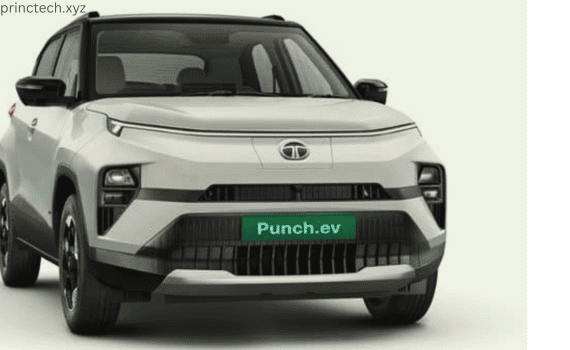
The Tata Punch EV is Nepal’s most talked-about affordable electric SUV priced from RS 34,99000 lakh. But is the claimed range honest? Does it handle Kathmandu’s hills? And how does it compare to the BYD Dolphin? Every answer below uses verified data, no filler.

Quick verdict | Tata Punch EV Nepal 2026
Best value feature-packed electric micro-SUV for Kathmandu commuters. Exceptional tech at this price, solid safety, and real running costs under RS 2,500/month. Not ideal for frequent long-distance or remote travel due to real-world range limitations and charging gaps outside the valley.
Tata Punch EV price in Nepal 2026
The authorized distributor of Tata vehicles in Nepal, currently offers the Punch EV in three variants.
| Variant | Battery | Motor | MIDC Range | Price (Nepal) |
|---|---|---|---|---|
| Empowered+ S MR Standard Range |
25 kWh | 60 kW / 81.5 PS 114 Nm |
315 km | Rs 34,99,000 |
| Empowered LR Long Range |
35 kWh | 90 kW / 122 PS 190 Nm |
421 km | Rs 37,99,000 |
| Empowered+ S LR Long Range Top |
35 kWh | 90 kW / 122 PS 190 Nm |
421 km | Rs 39,99,000 |
All three variants are distributed exclusively through Sipradi Trading. The company has expanded delivery beyond Kathmandu to Pokhara, Chitwan, Bhairahawa, Butwal, Biratnagar, and Birtamod.
Financing note (April 2026): Most Nepali banks are currently offering EV auto loans at 7–8.49% per annum. On the base variant at RS 34,99000 lakh with a 40% down payment (RS 13,99000 lakh) and a 7-year loan at 7%, the estimated monthly EMI is approximately RS 31,500. Always confirm the current rate with your bank before applying.
Real-world range , what Nepali owners actually get
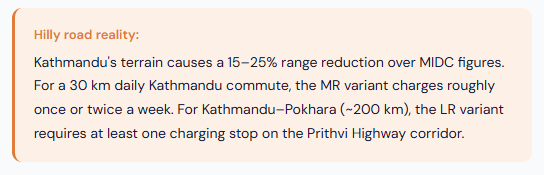
Tata’s MIDC-certified figures of 315 km (MR) and 421 km (LR) are measured under test conditions. In Nepal, where roads are hilly, traffic is dense, and AC runs most of the year, real-world range is materially lower. Based on Nepal-based owner reviews and independent road tests:
| Driving condition | MR variant (25 kWh) | LR variant (35 kWh) |
|---|---|---|
| Kathmandu valley — daily commute | 200–240 km | 270–310 km |
| Flat highway (Terai / Mahendra Hwy) | 240–280 km | 320–370 km |
| Hilly road (to Pokhara, Nagarkot, Dhulikhel) | 170–210 km | 230–280 km |
| Best real-world efficiency reported (Nepal) | 6.9 km/kWh (Automobile Hive Nepal road test) — yields ~240 km practical city range on MR | |
The 190 mm ground clearance is a genuine plus — it handles Kathmandu’s potholes, monsoon-damaged roads, and speed bumps without scraping. Regenerative braking (4 levels, paddle-controlled) is especially useful on downhill stretches, partly recovering energy lost on climbs.
Charging cost and time in Nepal
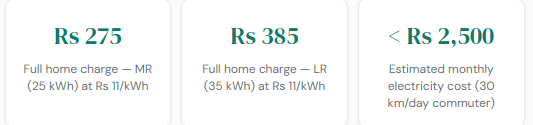
At NEA’s domestic electricity rate of approximately RS 11/kWh, the Punch EV is extraordinarily cheap to run. A full home charge costs:
| Charging method | MR (25 kWh) | LR (35 kWh) | Rate |
|---|---|---|---|
| AC home charger (7.2–7.5 kW) | 0–100% in 3.5–3.6 hrs | 0–100% in ~5 hrs | Rs 10–12/kWh (NEA domestic) |
| DC fast charger (public) | 10–80% in ~56 mins | 10–80% in ~56 mins | Rs 15–20/kWh (private operators) |
| NEA public charging stations | 62 NEA-operated stations nationally; expanding on Kathmandu–Pokhara and Kathmandu–Birgunj corridors | Rs 6–10.5/kWh | |
Charging gap warning: Several Nepal owner reviews note that high-power DC fast chargers specifically compatible with the Punch EV remain scarce outside Kathmandu Valley. If you live or regularly travel outside the valley, verify charging availability on your route before purchasing. Home charging overnight remains the most practical and cheapest option.
Key features and specifications
Built on Tata’s dedicated acti.ev platform — the same architecture used in the newer Nexon EV K3 and Curvv EV — the Punch EV’s feature list is punching well above its price bracket.
Technology and infotainment
| Feature | Detail | Variants |
|---|---|---|
| Infotainment screen | 10.2-inch touchscreen by Harman | All |
| Digital instrument cluster | 10.2-inch digital display | All |
| Wireless connectivity | Wireless Android Auto & Apple CarPlay | All |
| Audio system | 6-speaker Harman system | All |
| Connected car | iRA connected car app (remote monitoring, geofencing) | All |
| Wireless phone charging | Front + rear wireless pads | Empowered+ S |
| Sunroof | Single-pane electric sunroof | Empowered+ S |
Safety (Bharat NCAP 5-Star rated)
| Safety feature | Standard? |
|---|---|
| Airbags | 6 airbags — standard across all variants |
| ABS + EBD | Standard |
| ESC (Electronic Stability Control) | Standard |
| 360-degree surround camera | Standard |
| Blind View Monitor | Standard |
| ISOFIX child seat mounts | Standard |
| Hill Hold & Hill Descent Control | Standard |
| Electric Parking Brake with AutoHold | Standard |
| TPMS (Tyre Pressure Monitoring) | Higher variants |
Dimensions — why it works in Kathmandu
| Spec | Measurement | Nepal relevance |
|---|---|---|
| Length | 3,857 mm | Compact enough for Thamel, New Road, narrow valley lanes |
| Width | 1,742 mm | Fits standard Nepal parking spots comfortably |
| Height | 1,633 mm | SUV stance with good driver visibility |
| Wheelbase | 2,445 mm | Adequate rear legroom for 4 adults |
| Ground clearance | 190 mm | Handles potholes, monsoon-damaged roads with confidence |
| Boot space | 366 litres | Practical for family grocery runs and day trips |
| Kerb weight | 1,240–1,340 kg | Light enough for responsive city driving |
Warranty
- Battery & motor: 8 years / 160,000 km among the best in Nepal’s EV market
- Vehicle: 3 years / 125,000 km
Pros and cons for Nepal buyers
✓ Pros
- Lowest entry price in its class — Rs 34.99 lakh
- 5-star Bharat NCAP safety at this price is exceptional
- 6.9 km/kWh real efficiency — Rs <2,500/month running cost
- 190 mm ground clearance handles Nepal roads well
- 8-year battery warranty — strong long-term assurance
- Dual 10.2-inch screens, wireless connectivity, 360° camera
- Compact size ideal for Kathmandu’s narrow streets
- Sipradi’s nationwide service network — established and trusted
- 4-level regenerative braking — smart for downhill recovery
✗ Cons
- Real-world range (200–240 km) significantly below MIDC claim
- DC fast chargers for Punch EV scarce outside Kathmandu
- Software/infotainment glitches reported by some Nepal owners
- Not practical for frequent Kathmandu remote district routes
- 40% minimum down payment required under NRB LTV rules
Tata Punch EV vs competitors in Nepal
The Punch EV’s two closest rivals in Nepal are the BYD Dolphin (hatchback, larger battery) and the Tata Nexon EV (larger SUV, higher price). Here is how they compare on the metrics that matter most for Nepal:
| Spec / criteria | Tata Punch EV LR | BYD Dolphin | Tata Nexon EV |
|---|---|---|---|
| Price (Nepal, April 2026) | Rs 37.99–39.99L | Rs 38–40L (approx.) | Rs 46.49L (approx.) |
| Battery capacity | 35 kWh | 44.9 kWh (Blade) | 45 kWh |
| Motor power | 90 kW — stronger | 70 kW | 98 kW |
| Real-world range Nepal | 270–310 km | 320–380 km — better | 300–340 km — better |
| Ground clearance | 190 mm | 130 mm | 205 mm — best |
| Bharat NCAP safety | 5-star | Not tested | 5-star |
| Airbags | 6 | 6 | 2 (base) / 6 (higher) |
| V2L (power external devices) | No | Yes | Yes |
| Body type | Micro-SUV | Hatchback | Compact SUV |
| Best for | City commuting, tight budget, feature-seekers | Range priority, budget-conscious | Long-distance, family SUV buyers |
| Best for | City commuting, tight budget, feature-seekers | Range priority, budget-conscious | Long-distance, family SUV buyers |
Key comparison takeaway: The BYD Dolphin’s Blade Battery gives it a meaningful range advantage, but the Punch EV wins on motor power, ground clearance, safety rating, and infotainment. The Nexon EV is the better all-rounder for Nepal’s diverse terrain but costs Rs 7–9 lakh more. For pure city value, the Punch EV is hard to beat.
5-year running cost: Punch EV vs petrol car
At today’s NOC petrol price of Rs 219/litre and NEA home charging at Rs 11/kWh, the 5-year numbers are stark. Assumes 75,000 km over 5 years.
| Cost category | Tata Punch EV (MR) | Comparable petrol car | EV saving |
|---|---|---|---|
| Purchase price | Rs 34.99 lakh | Rs 26–30 lakh | –Rs 5–9 lakh (upfront) |
| Fuel / charging (75,000 km) | ~Rs 2.7 lakh | ~Rs 13.7 lakh | +Rs 11 lakh |
| Annual road tax (5 yrs) | ~Rs 0.5 lakh total | ~Rs 1.5 lakh total | +Rs 1 lakh |
| Maintenance (oil, filters, exhaust) | ~Rs 0.7 lakh | ~Rs 2.2 lakh | +Rs 1.5 lakh |
| 5-year total (approx.) | ~Rs 38.9 lakh | ~Rs 47.4 lakh | +Rs 8.5 lakh saved |
The breakeven point where cumulative savings offset the higher purchase price falls at approximately 2.5–3 years for a typical Kathmandu commuter. Monthly fuel savings alone exceed RS 12,500 at current petrol prices.
Is the Tata Punch EV worth buying in Nepal 2026?
Buy the Punch EV if:
- You commute daily within Kathmandu Valley (30–60 km/day) this is the car’s sweet spot
- You want the maximum technology and safety features under Rs 40 lakh
- Home charging access is available overnight charging is the cheapest, most convenient option
- Brand trust and Sipradi’s national service network matter to you
- You are upgrading from a hatchback and want SUV stance without a large car’s price
Think twice if:
- You regularly drive Kathmandu to remote districts where charging points don’t yet exist
- You need V2L (power-cut backup from the car battery) — consider BYD Dolphin or Nexon EV instead
- You’re a tall driver or regularly carry 4–5 tall adults — rear legroom is the Punch EV’s biggest interior constraint
- Your household cannot install a home charger and public DC fast chargers in your area are limited
FAQs — Tata Punch EV Nepal 2026
What is the price of Tata Punch EV in Nepal in 2026?
As of April 2026, the Tata Punch EV price in Nepal starts at Rs 34,99,000 for the Empowered+ S Standard Range (25 kWh). The Empowered Long Range is priced at Rs 37,99,000, and the top Empowered+ S Long Range costs Rs 39,99,000. All prices are from Sipradi Trading, the authorised distributor in Nepal. Prices increased by Rs 1 lakh across all variants in late 2024.
What is the real-world range of Tata Punch EV in Nepal?
In Nepal’s real conditions hilly roads, AC use, Kathmandu traffic the Standard Range (MR) variant delivers approximately 200–240 km per charge, and the Long Range (LR) variant delivers approximately 270–310 km. This is significantly below Tata’s MIDC-certified claims of 315 km (MR) and 421 km (LR), which are measured under ideal test conditions. A Nepal road test (Automobile Hive) recorded 6.9 km/kWh efficiency, yielding around 240 km practical city range on the MR variant.
How much does it cost to charge the Tata Punch EV at home in Nepal?
At NEA’s domestic electricity rate of approximately Rs 11/kWh, a full home charge costs around Rs 275 for the MR variant (25 kWh) and Rs 385 for the LR variant (35 kWh). For a commuter driving 30 km per day, monthly electricity costs are well under Rs 2,500 — compared to Rs 15,000–18,000 per month in petrol at current NOC prices of Rs 219/litre.
Does the Tata Punch EV handle hilly roads in Nepal well?
Yes, for typical Nepal hilly roads. The 190 mm ground clearance handles potholes and uneven surfaces confidently. The 4-level regenerative braking system (paddle-controlled) recovers energy on downhill stretches, partly compensating for energy lost climbing. Nepal road testers rate the Punch EV’s ride comfort as one of the best in its segment on rough roads. However, sustained high-altitude routes (Mustang, Kalinchowk, Thorong La) will reduce range by 20–30% and are not recommended for the MR variant without charging stops.
Tata Punch EV or BYD Dolphin — which is better for Nepal?
It depends on your priority. The Tata Punch EV wins on motor power (90 kW vs 70 kW), ground clearance (190 mm vs 130 mm), Bharat NCAP 5-star safety rating. The BYD Dolphin wins on battery size (44.9 kWh vs 35 kWh), real-world range, and V2L capability (powering devices during load-shedding) which the Punch EV does not offer. For city commuting and feature value, Punch EV wins. For range and power-cut backup, BYD Dolphin wins.